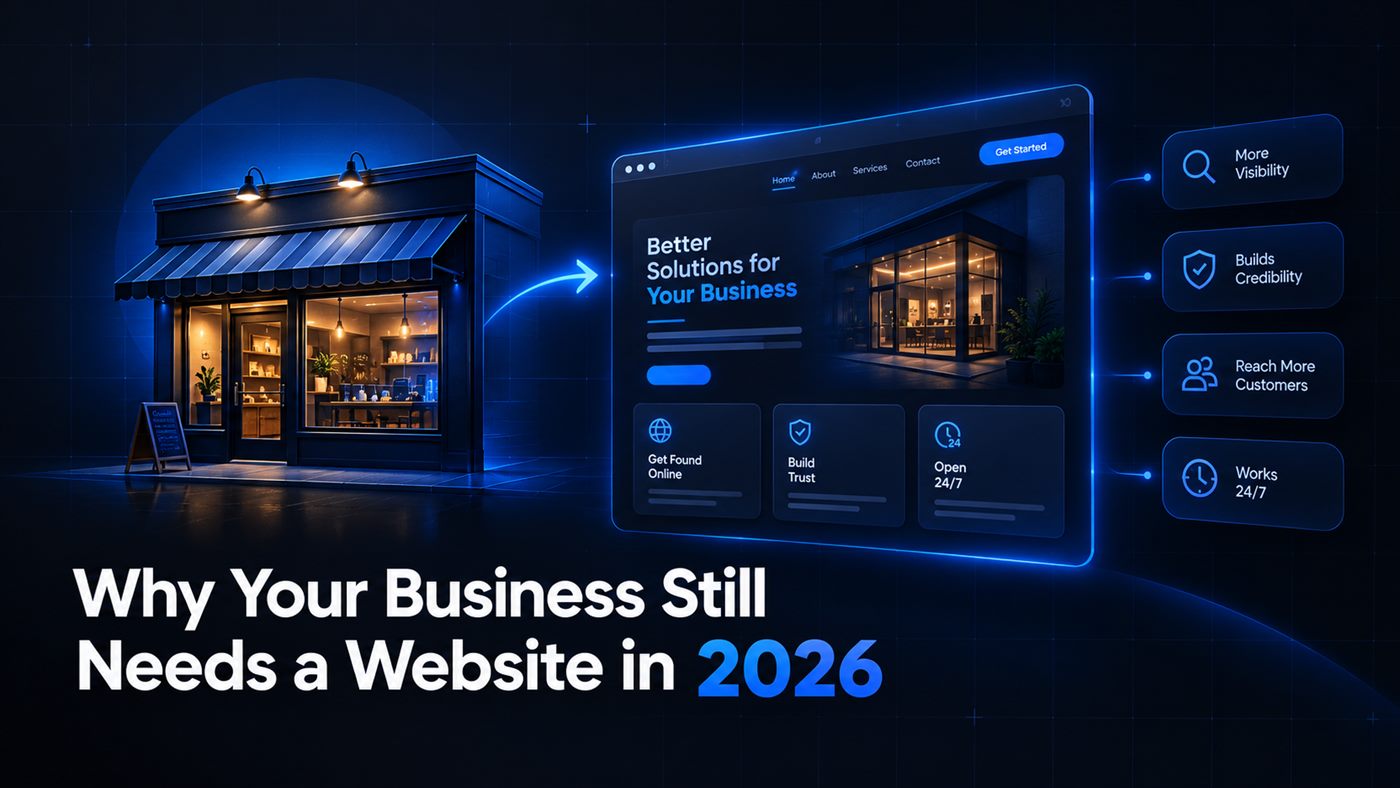
For many small businesses, the first place a potential customer discovers them is no longer a physical storefront.
It might be Google.
It might be Instagram.
It might be TikTok.
It might be a WhatsApp status, a Facebook post, a recommendation from a friend, or a Google Maps search while someone is already looking for a product or service.
With so many platforms available, it is reasonable for a business owner to ask:
"Do I really need a website anymore?"
The short answer is that a business can operate without one.
But operating without a website can create limitations that become increasingly important as the business grows.
A social media profile can help people discover your business. A marketplace can help you sell. WhatsApp can help you communicate with customers.
A website can bring these pieces together into a digital home that your business controls.
And in 2026, that matters.
Your Business Needs More Than a Social Media Profile
Social media has become one of the most important tools for modern businesses.
Platforms such as Instagram, Facebook, TikTok, LinkedIn, and X can help businesses reach large audiences without spending money building their own audience from scratch.
But there is an important distinction:
You are using someone else's platform.
Your business does not control how the platform's algorithm works.
You do not control which posts receive visibility.
You do not control when features change.
You do not control whether an account gets restricted or suspended.
And you do not control how the platform presents your business to potential customers.
A website gives you another option.
Instead of asking customers to find your business through a particular social network, you can give them a direct destination.
For example:
YourBusiness.com
That address can appear on your business cards, Google Business Profile, social media profiles, advertisements, invoices, packaging, email signatures, and WhatsApp conversations.
One address can connect customers to your entire business.
A Website Builds a Central Digital Presence
Imagine a customer discovers your business on Instagram.
They want to know:
- What exactly do you sell?
- Where are you located?
- How much do your services cost?
- How can they contact you?
- Do you deliver?
- What are your opening hours?
- Do you have previous work they can see?
- How can they place an order?
- Are you a legitimate business?
- Can they trust you?
You could answer all of these questions through messages.
But that creates friction.
The customer has to ask.
You have to respond.
And another customer may ask the exact same questions five minutes later.
A well-structured website can answer many of those questions immediately.
Your homepage can explain what you do.
Your services page can explain what you offer.
Your portfolio can demonstrate your work.
Your contact page can provide multiple ways to reach you.
Your FAQ can answer common questions.
Your policies can explain important terms.
Your website becomes a central source of information.
Instead of repeatedly explaining your business, you can send someone one link.
Your Website Works While You Sleep
One of the biggest advantages of a website is simple:
It is available even when you are not.
Your physical business may close at 6 PM.
You may stop answering WhatsApp messages at 9 PM.
You may not respond to social media messages until the next morning.
Your website, however, can continue presenting your business information around the clock.
A customer researching a service at midnight does not necessarily need to contact you immediately.
They may simply want to understand what you offer.
If your website answers their questions, you have already moved them further through the buying process.
They can return the next morning and contact you when you are available.
This does not mean a website automatically generates customers.
It means your business has a digital presence that does not depend entirely on you being online at that exact moment.
Google Search Is Still Important
Consider what happens when someone searches:
"Best barber near me"
or:
"Website designer in Nairobi"
or:
"Beauty shop near me"
or:
"Affordable accounting services"
People searching these terms already have some level of intent.
They are looking for something.
For businesses that serve local customers, appearing in search results can therefore be valuable.
A website can provide Google and other search engines with additional information about your business, your services, your location, your expertise, and the topics you cover.
This is where search engine optimization, commonly called SEO, becomes relevant.
SEO is not simply about adding keywords to a page.
Good SEO involves creating useful content, organizing information properly, making pages accessible to search engines, improving technical performance, earning relevant links and mentions, and making the website genuinely useful to visitors.
A website gives your business a foundation on which these efforts can be built.
Your Website Can Strengthen Your Google Business Presence
For businesses that serve a particular geographic area, a Google Business Profile can be extremely useful.
A potential customer may discover your business through Google Search or Google Maps.
They might see:
- Your business name
- Location
- Opening hours
- Phone number
- Reviews
- Photos
- Services
- Website
- Directions
Your website and your Google Business Profile can therefore work together.
Your Google presence helps people discover you.
Your website gives them somewhere to learn more.
Your social media can show your brand and activity.
Your messaging channels can provide direct communication.
These platforms do not necessarily have to compete with one another.
They can form a connected digital ecosystem.
A Professional Website Can Establish Trust
Trust is one of the biggest factors in any purchase decision.
Before giving a business their money, customers often want reassurance that they are dealing with a legitimate organization.
A professional website cannot guarantee trust.
But a poorly designed, incomplete, or confusing online presence can create unnecessary doubt.
Compare two businesses.
Business A has a social media page with a few posts and a phone number.
Business B has a social media page, a Google Business Profile, a professional website, clear contact information, service descriptions, a portfolio, business information, and clear policies.
The second business has provided customers with more information to evaluate.
That additional information can reduce uncertainty.
This is particularly important for businesses selling services.
If you are asking a customer to trust you with their website, finances, project, event, home, education, beauty services, or another important purchase, your digital presence becomes part of the customer's research process.
Your Website Should Not Just Look Good
There is a common misconception that a good website is simply a beautiful website.
Design matters.
But design is only one part of the equation.
A website also needs to work.
That means customers should be able to understand:
What does this business do?
Who is it for?
Why should I care?
What should I do next?
If someone lands on your homepage and cannot answer those questions within a reasonable amount of time, the design is not doing enough.
A modern business website should balance several things:
- Visual design
- Clear messaging
- Performance
- Mobile responsiveness
- Accessibility
- Search visibility
- Navigation
- Security
- Contact functionality
- Content
- Conversion paths
The goal is not to build a website that simply looks impressive.
The goal is to build a website that helps people understand and interact with the business.
Mobile Matters
A website can look excellent on a desktop computer and still provide a poor experience on a phone.
That is a serious problem.
Customers increasingly interact with businesses through mobile devices.
Someone may discover your business while sitting on a bus.
They may search for your service while walking through town.
They may open your website from an Instagram profile.
They may click your link from WhatsApp.
They may search Google from their phone.
If the website requires excessive zooming, has tiny buttons, broken layouts, slow-loading images, or difficult navigation, potential customers may simply leave.
Responsive design helps ensure that your website adapts to different screen sizes.
A good website should not force your customer to fight with the interface.
The technology should adapt to the customer.
Website Speed Matters Too
Nobody likes waiting for a website to load.
Large images, unnecessary scripts, poorly optimized code, excessive animations, and inefficient hosting can all contribute to slow performance.
A slow website can create a poor user experience.
It can also affect how search engines evaluate and display pages.
This is why performance should be considered during development rather than treated as an afterthought.
A professional website should aim to:
- Optimize images
- Reduce unnecessary scripts
- Use efficient code
- Minimize excessive animations
- Cache resources where appropriate
- Use reliable hosting
- Monitor performance
- Keep third-party integrations under control
A beautiful website that takes too long to load is still a poor website.
Your Website Can Become Your Sales Assistant
Think about everything a salesperson might explain to a potential customer.
They might describe:
- The company's services
- Different packages
- Pricing
- Features
- Benefits
- Previous projects
- Frequently asked questions
- How the process works
- How to get started
Your website can communicate much of this information before a conversation even begins.
For example, a web design business could have:
Website Launch
For businesses starting from scratch.
Website Upgrade
For businesses with an existing website that needs improvement.
Website Care
For businesses that need ongoing maintenance and support.
Instead of simply telling someone:
"We build websites."
the website can explain exactly what that means.
This makes the business easier to understand.
Your Website Can Showcase Your Work
For service businesses, telling people what you can do is useful.
Showing them is better.
A portfolio can demonstrate previous work through:
- Screenshots
- Case studies
- Before-and-after examples
- Project descriptions
- Client goals
- Solutions provided
- Results where those results can be documented accurately
For example, instead of saying:
"We create modern websites."
you can show an actual website you built.
Instead of saying:
"We improve existing websites."
you can demonstrate how a previous website was redesigned.
Evidence gives customers something concrete to evaluate.
Content Can Bring People to Your Business
A website does not have to consist only of static pages.
A blog can become an important part of your digital strategy.
Suppose you operate a beauty business.
You could publish articles about:
- How to choose the right skincare routine
- Common beauty mistakes
- Product care
- Seasonal beauty trends
- How to prepare for an event
A financial services business could publish:
- Budgeting guides
- Saving strategies
- Financial terminology
- Business finance explanations
- Industry developments
A technology company could publish:
- Website security guides
- Technology explainers
- Business automation ideas
- Website maintenance tips
- Digital transformation articles
These articles can help answer questions that potential customers are already asking.
Over time, useful content can create additional opportunities for people to discover the business through search.
Your Website Can Help You Own Your Brand
There is an important difference between having an online presence and owning your digital identity.
Your social media username is controlled by a platform.
Your marketplace profile is controlled by a marketplace.
Your advertising account exists within an advertising network.
Your website domain is different.
When you own a domain such as:
yourbusiness.com
you have a direct web address associated with your business.
You can build your website around it.
You can create professional email addresses around it.
You can put it on marketing materials.
You can build search visibility around it.
And you can keep that identity while changing the technology powering the website behind the scenes.
The domain becomes part of your brand infrastructure.
Professional Email Is Another Advantage
A website domain can also support professional business email.
Compare:
yourbusiness@gmail.com
with:
hello@yourbusiness.com
Neither address automatically makes a company trustworthy.
However, a domain-based email can create a more consistent professional identity when combined with an established business presence.
You can also create different addresses for different purposes.
For example:
- hello@yourbusiness.com
- support@yourbusiness.com
- sales@yourbusiness.com
- info@yourbusiness.com
This can make customer communication more organized as a business grows.
A Website Can Reduce Repetitive Questions
Imagine you run a small business and receive the same questions every day.
"What are your prices?"
"Where are you located?"
"What time do you close?"
"Do you deliver?"
"How long does the service take?"
"How do I book?"
"What payment methods do you accept?"
You can answer every message manually.
Or you can create a website that answers these questions clearly.
That does not eliminate customer communication.
Instead, it allows you to spend more time on conversations that actually require human interaction.
Your website handles information.
You handle relationships.
A Website Does Not Replace Social Media
This is important.
Getting a website does not mean you should abandon social media.
In many industries, social media remains extremely valuable for discovery, community building, demonstrations, entertainment, announcements, and customer interaction.
The better approach is often to connect the two.
For example:
Social media → Website → Contact/Booking/Purchase
Someone sees your content on Instagram.
They click your website.
They learn about your business.
They view your work.
They read your services.
They decide they are interested.
They contact you.
That is a much more complete customer journey than relying on a social profile alone.
Not Every Business Needs a Complicated Website
Another misconception is that every business needs an enormous website with dozens of pages and advanced features.
That is not true.
A local service business might only need:
- Home
- About
- Services
- Portfolio
- Contact
A restaurant might need:
- Home
- Menu
- Location
- Reservations
- Contact
A freelancer might need:
- Home
- Services
- Portfolio
- About
- Contact
An online store will require considerably more functionality.
The correct website depends on the business.
More pages do not automatically mean more value.
A simple website that clearly communicates the right information can be more useful than a complicated website filled with unnecessary features.
What Makes a Business Website Effective?
A strong business website generally has a few characteristics in common.
1. Clear Positioning
Visitors should quickly understand what the business does.
2. Clear Calls to Action
Customers should know what to do next.
That might be:
- Call
- Book
- Buy
- Request a quote
- Send an email
- Visit the business
3. Useful Information
The website should answer the questions customers actually have.
4. Professional Presentation
The visual design should match the type of business and audience.
5. Mobile Responsiveness
The website should work properly across different screen sizes.
6. Good Performance
Pages should load efficiently.
7. Security
Forms, accounts, payments, and other sensitive functionality should be implemented responsibly.
8. Accessibility
People with different abilities should be able to navigate and interact with the website.
9. Search-Friendly Structure
The website should provide search engines with understandable, well-organized content.
10. Accurate Information
Business names, addresses, phone numbers, prices, services, opening hours, and other important information should be kept current.
What About the Cost?
One reason small businesses avoid websites is cost.
And this concern is understandable.
A website can involve several expenses:
- Domain registration
- Hosting
- Design
- Development
- Copywriting
- Photography
- Branding
- Maintenance
- Third-party services
- E-commerce or payment systems
The important question is not simply:
"How much does a website cost?"
A better question is:
"What does my business actually need?"
A five-page service website and a large e-commerce platform are completely different projects.
Instead of paying for features you do not need, a business should identify the actual problem the website is supposed to solve.
A Website Is an Investment, Not a Magic Button
There is one thing business owners should understand before investing in a website:
A website does not automatically produce customers.
Simply launching a website does not guarantee traffic.
It does not guarantee sales.
It does not guarantee Google rankings.
It does not guarantee viral growth.
A website is infrastructure.
You still need good products or services.
You still need marketing.
You still need customer service.
You still need accurate information.
You still need to build trust.
You may also need SEO, advertising, social media, partnerships, referrals, email marketing, or other customer acquisition strategies.
The website is one component of the larger business system.
The Real Value of a Website
The value of a website is not simply that it exists.
The value comes from what it allows your business to do.
It can give customers a place to learn about you.
It can make your business easier to find.
It can showcase your work.
It can collect enquiries.
It can support bookings.
It can sell products.
It can publish useful information.
It can connect your different marketing channels.
It can establish a consistent digital identity.
It can reduce repetitive communication.
And it can give your business a digital foundation that you control more directly than a social media profile.
So, Does Your Business Need a Website?
There is no universal answer.
If your business operates entirely through a platform and your current model works, you may not need a complex website immediately.
But if customers regularly search for your business, ask the same questions repeatedly, need information before buying, or struggle to understand what you offer, a website can solve real problems.
The important thing is not to build a website simply because everyone says you should.
Build one because it serves a purpose.
Your website should help your customers.
It should help your business.
And it should support the way you actually operate.
Start With the Business Problem
Before building anything, ask:
What problem should this website solve?
Maybe customers cannot find you.
Maybe your current website looks outdated.
Maybe people cannot understand your services.
Maybe you receive too many repetitive questions.
Maybe you need an online booking system.
Maybe you want to sell products online.
Maybe your business has grown beyond social media.
Maybe you simply need a professional digital home.
Once you understand the problem, the technology becomes much easier to choose.
You do not need to build the biggest website.
You need to build the right website.
Final Thoughts
The internet has changed significantly over the years.
Businesses now have more ways than ever to reach customers.
Social media.
Search engines.
Marketplaces.
Messaging apps.
Online communities.
Digital advertising.
Email.
And websites.
The goal is not to choose one platform and ignore everything else.
The strongest digital presence can come from making these channels work together.
Social media can help people discover you.
Search can help people find you when they have a need.
Your website can explain who you are and what you offer.
Your communication channels can help customers take the next step.
And your business can continue building its digital presence over time.
A website is not a substitute for a good business.
It is a tool that can help a good business become easier to discover, understand, and interact with.
Build for the customer first. Build for the business second. And build technology around the actual problem—not the other way around.
Ready to Build or Improve Your Business Website?
At Alphacent Inc., we focus on building and improving digital systems for growing businesses.
Whether you are starting from zero, working with an outdated website, or need ongoing support, the right approach depends on where your business is today and where you want it to go.
Explore our services:
- Alphacent Launch — Build your business's digital foundation.
- Alphacent Upgrade — Improve an existing website and digital experience.
- Alphacent Care — Keep your digital systems maintained, secure, and up to date.
Your business is already doing the work.
Your digital presence should help it do more.